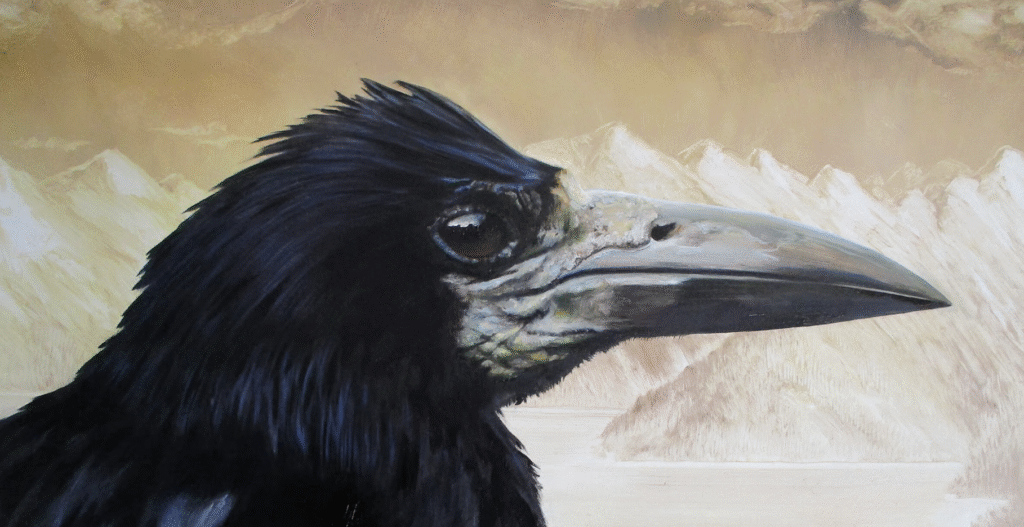
Rooks: Stop the Poisoning and Reassess the Evidence
Flora & Fauna are calling for an immediate pause to the poisoning and eradication of rooks (Corvus frugilegus) in Hawke’s Bay and other areas including Canterbury. Our primary concern is animal welfare and the wrongful targeting and vilification of the Rook species.
Rooks are being deliberately poisoned as part of an ongoing eradication programme, yet serious questions remain about the welfare consequences of the toxin being used. We believe it is unacceptable to continue killing wildlife using a method associated with severely negative welfare impacts – and in particular, proceeding with eradication while important questions about the evidence used to justify eradication remain unresolved.
For more information on rook please see the following websites:
www.therookywood.com – Artist and Animal Advocate Kate White
Read our press release below, and take action:
Take Action for Rooks:
1. Write to your local councillor in the Hawke’s Bay and ask them to support bringing a halt to the eradication of rooks.
2. Write to your local paper about the cruel culling of rooks
3. Sign the petition to Parliament to stop the cull and save the rooks
4. Put up a printed sign on your fence or in your shop window (See the printable signs here)
5. Call the HBRC and make a complaint about their use of cruel poisons to kill rooks
6. Call or write to the SPCA to make a report of animal cruelty and request they record your concerns
Find useful information and key points here to help you when writing to Councils or SPCA.
The Cruel Eradication of Sentient Rooks Must Stop
Flora and Fauna press release September 2026
A poison programme targeting the last remaining rooks in the Hawke’s Bay has begun this September and is intended to continue for serval months throughout the rook breeding season.
The Hawke’s Bay Regional Council is asking the public to report sightings so the birds can be killed as part of the programme. But many local residents and animal welfare advocates across the country, including Flora and Fauna, are calling for an immediate halt to the rook eradication programme.
Flora and Fauna has made an appeal to The Hawke’s Bay Regional Council to pause the programme and undertake a proper review of the evidence that rooks require eradication. However, the Council has indicated that it intends to continue with this season’s poisoning, leaving a review for 2028, thus ignoring the serious ethical and animal welfare concerns that have been raised.
Cruelty is Never Justified
The Council’s Rook control uses the toxin DRC1339, which is produced by the State Owned Enterprise (SOE) Orillion. The Ministry of Agriculture and Forestry’s 2010 report, “How Humane are our Pest Control Tools?”, described the use of DRC1339 on rooks as causing “severe negative welfare impacts over a duration of hours”. Death following ingestion can take several hours and, depending on dosage, potentially longer.
Flora and Fauna spokesperson Asha Andersen states:
“One of the most horrific aspects of this is that Council contractors drop the poison into rook nests from a helicopter. The parents then feed the poison to their young, where they suffer and die in the nest over hours in agony. It’s absolutely appalling that we are treating wildlife like this. They are recognised as sentient beings. They deserve to be treated humanely.”
“We believe the animal welfare issue should be enough to demand a serious reassessment. If a species is going to be deliberately eradicated using a method known to cause prolonged suffering, you would think there must be compelling evidence that such extreme action is necessary, but the truth is, there isn’t compelling evidence at all – and such extreme cruelty is never necessary or justifiable.”
Rooks Provide a Natural Bio Control Service
Rooks were deliberately introduced to New Zealand in the 1860s and 70s because of their value to agriculture and pastoral farming, particularly their role in controlling invertebrate pests. They were also highly valued for their beauty and unique communal rookeries that can be seen across the European continent. They have now been in New Zealand for over 160 years and had well established themselves in the Hawke’s Bay and other areas, without having a negative impact on our own native flora and fauna.
In the United Kingdom and across Europe, rooks are recognised as part of agricultural ecosystems as they are well known to consume pests such as grass grub, and they are also valued for their seed dispersal and sterilising fields by breaking down dung and carrion.
Rooks have a legitimate and useful role in pastoral ecosystems and in other countries around the world this is well recognised. They are natural predators of insect pests and provide biological pest control without the need for chemical intervention. While it is known that in between seasons when some food sources become scarce they sometimes turn to crops or seedlings – a behaviour that is intermittent and can be mitigated with other non-lethal methods.
In New Zealand, it should be noted that the grass grub problem costs farmers and the country billions in lost productivity and forces the use of highly toxic chemical treatments. At a time when agriculture is looking for ways to reduce reliance on harmful pesticides, the contribution of rooks should be recognised rather than dismissed. Removing them eliminates a natural predator and risks leaving farmers more dependent on chemical methods to control the pests that rooks help consume.
Hawke’s Bay artists and animal advocates, including Kate White say that eradication is totally unnecessary. Kate White says, “The UK has almost 1 million pairs of Rooks and no major grass grub problems. New Zealand is waging a losing battle with the grass grub, currently costing us $2 billion/year and requiring the use of highly toxic chemicals which adversely affect man and the environment, and yet we are eradicating our Rooks.”
“The Rook situation in NZ is dire. There are officially less than 250 active nests left in Hawke’s Bay: their last most populous province. They are now considered extinct in the South Island.”
Before continuing with an unjustified and an irreversible eradication programme, we need independent research into the true agricultural role rooks provide, including their consumption of grass grub and other pasture pests. Once rooks are gone from our landscapes, we cannot go back and properly investigate what role they may have played in New Zealand’s agricultural ecosystems nor can we then vindicate them of unscientific claims that they are villains.
This is not an argument against responsible pest management, quite the opposite, it is a call for evidence-based decision-making and humane treatment of wildlife. Simply put, we should not eradicate first and investigate later.
Flora and Fauna is calling for:
- An immediate moratorium on all rook eradication programmes.
- Independent research into the ecological role of rooks, particularly their consumption of grass grub and other pasture pests.
- A comprehensive review of the animal welfare impacts of DRC1339.
- An end to the use of cruel poisoning methods used to kill rooks and other wildlife.
To learn more about the rook situation in New Zealand and to take action, please visit the Flora and Fauna website. www.floraandfaunaaotearoa.co.nz
Key points for writing to the SPCA and Councils such as Hawke’s Bay and Canterbury who are engaging in eradication programs.
Please contact the SPCA and Regional Councils with your concerns that the poisoning of our Rooks is unnecessary, cruel and breaks the Animal Welfare laws of NZ which are meant to extend to wild animals as well as domestic. It is important that you ask them to record that you were in touch with them and record your concerns.
Some points to consider:
1. According to this 2010 MAF paper (pg 6) https://www.mpi.govt.nz/dmsdocument/4009-Howhumane-are-our-pest-control-tools/ the use of DRC1339 on rooks created “severe negative welfare
impacts over a duration of hours”
2. And according to this 2020 MPI report (pg 15) ( https://www.bionet.nz/assets/Uploads/A6-PestRooks-2018-04-LR.pdf) “The time until death is variable and depends on the amount of toxic baiteaten. Most birds will die within four days but can do so in as little as three hours.”
3. This makes a travesty of MPI’s boasting about high standards for some, but not others:
https://www.mpi.govt.nz/animals/animal-welfare/animal-welfare-overview/ “Animal
welfare overview: “It matters how animals are treated. We all have responsibilities toward animals in our care and those affected by our activities. MPI helps develop policy and enforce animal welfare in New Zealand. Animals play an important role in many New Zealanders’ lives – they offer food and fibre, income and companionship, education, research and entertainment. Animals work alongside us, entertain us, compete with us, and are even managed as pests. These relationships are accepted, as long as they are humane.”
For those wanting more info on Rooks:
4. Rook’s memory: https://pmc.ncbi.nlm.nih.gov/articles/PMC11880163/
5.Rooks are capable of making tools:
https://www.qmul.ac.uk/news/latest-news/2009/se/rooks-show-insightful-and-creative-tool-use.html#:~:text=Researchers%20at%20Queen%20Mary%2C%20University,hook%20to%20reach%20the%20food
“We suggest that this is the first unambiguous evidence of animal insight because the rooks made a hook tool on their first trial and we know that they had no previous experience of making hook tools from wire because the birds were all hand-raised,” said Dr Nathan Emery, from Queen Mary’s School of Biological and Chemical Sciences.
These findings suggest that rooks’ ability to use tools and represent the tools’ useful properties may be a by-product of a sophisticated form of physical intelligence, rather than tool use having evolved as an adaptive specialisation, such as has been proposed for the tool using abilities of New Caledonian crows.”
6. Rooks are capable of sophisticated physical cognition and have shown themselves possessing of similar intellectual capacity as a 7-year-old child.
7. Avicides like DRC1339 are banned in the EU. New Zealand occupies the most barbaric end of the animal control scale.